Sunday, June 13, 2010

Wailing Wall


There I am! On a camel!! That's my friend Jan behind me. What fun! We are on the top of the Mount of Olives. From here we can look across the Valley of Judgement to see the house of the Last Supper, Caiphus' house, and the rest of Jerusalem. It was a big WOW!


Right next door is the Garden of Gethsemane (Gethsemane means olive press). In the church located there called the Church of All Nations or Church of Agony is the rock that Jesus prayed on. The tree you see here is at least 2000 years old. All the trees in the garden are ancient except the one planted in the 1990's by the pope.

This is the Wailing Wall or the West Wall. After all the destruction from various wars, this is the only one still standing. It is unbelievable. The bottom blocks are 300 tons! It is built with one block on top of another - no mortar. The small blocks are 2.5 tons!
It is a sacred wall because directly on the other side of the wall is where the Holy of Holies was. Praying at the wall is as close as you can get to being with God.


I cannot tell you how this day has affected me. To put my hand on the rock Jesus prayed and sweated and bled on as he waited for Judas and the soldiers to come and arrest him, then to put my hand on the West Wall and hold all of you in prayer, my family, my friends, my church and myself. I was drained and at the same time encouraged.
Let us pray - God, creator and almighty, merciful, compassionate Lord, I give you thanks for sending your Son, for walking with me, for always being there. Amen

Saturday, June 12, 2010

O Little Town of Bethlehem


Today was the day for nativity. We went to The House of the Outrageous Caiaphas first, though. The archaeologists are certain that the villa uncovered was his house, found the room he was beaten in while the trial was going on, and found the pit 3 stories down that he was lowered into for the night a pit dug out of the stone that was probably 6 foot across. From there the next morning he was taken to Pilot.


"So Joseph also went up from the town of Nazareth in |Galilee to Judea, to Bethlehem the town of David, because he belonged to the house and line of David....While they were there, the time came for the baby to be born, and she gave birth to her firstborn, a son. She wrapped him in cloths and placed him in a manger, because there was no room for them in the inn." Luke 2: 4-7
From there we went to the Church of the Nativity, yes to the very cave where Mary birthed Jesus. Yes the star is the birthing place. Three churches, the Armenian, the Greek Orthodox, and the Catholic church all take turns 'owning' the birthplace by procession into the cave and literally homesteading for a day. Incredible. So all three have churches on site and little doors leading to the birthplace that they do their procession from. The church of the Nativity is in Bethlehem - across the Wall into the Palestinian occupied territory. That is a discussion we must have sometime.

And low and behold the coffee shop across the street!!!


A prayer: Lord help our hearts to see with eyes only you truly have. Amen

Friday, June 11, 2010

Away from Galilee

We left the beautiful Sea of Galilee and headed east for Cana to see the church which is on top of the original house where Jesus's first miracle of changing water into wine occurred. We have many couples in our group and they renewed their wedding vows today - complete with a certificate from the church!
Next we were off to Megiddo. This is an ancient city. There are 25 cities one built right on top of the other. The last was vacated in the 4th century BCE. You will have heard of Armageddon - that is the final war, a war between good and evil, between all the kings, all the nations found in Rev. 16:16 "Then they gathered the kings together to the place that in Hebrew is called Armageddon." An interesting city on a hill that is at the crossroads of all travel in the middle east.
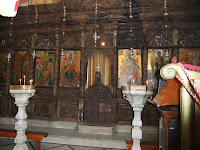
From there we went to Nazareth, the city where Jesus grew up. There we found the most beautiful Greek Orthodox church with the spring that was the purpose for the town. Nazareth's root word in Hebrew is grandfather - as in the grand fathers of Jesus, those of the past. Wow!


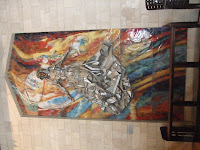
Then we visited the Basilica of St. Mary where countries from around the world have sent their depiction of Mary. Took a picture of the one from the US.Sorry the picture is on its side. Can't fix it on this computer.
Finally, we were on our way to Jerusalem. Staying until the 17th here. Beautiful hotel. OH!! Saw muskrats in the Jordan River yesterday as people affirmed their baptism. Soooo cute.

Blessings. On to Bethlehem tomorrow.

Thursday, June 10, 2010

What a day!!!

John 21:1-16
After these things Jesus showed himself again to the disciples by the Sea of Tiberias; and he showed himself in this way. 2Gathered there together were Simon Peter, Thomas called the Twin, Nathanael of Cana in Galilee, the sons of Zebedee, and two others of his disciples. 3Simon Peter said to them, “I am going fishing.” They said to him, “We will go with you.” They went out and got into the boat, but that night they caught nothing. 4Just after daybreak, Jesus stood on the beach; but the disciples did not know that it was Jesus. 5Jesus said to them, “Children, you have no fish, have you?” They answered him, “No.” 6He said to them, “Cast the net to the right side of the boat, and you will find some.” So they cast it, and now they were not able to haul it in because there were so many fish. 7That disciple whom Jesus loved said to Peter, “It is the Lord!” When Simon Peter heard that it was the Lord, he put on some clothes, for he was naked, and jumped into the sea. 8But the other disciples came in the boat, dragging the net full of fish, for they were not far from the land, only about a hundred yards off. 9When they had gone ashore, they saw a charcoal fire there, with fish on it, and bread. 10Jesus said to them, “Bring some of the fish that you have just caught.” 11So Simon Peter went aboard and hauled the net ashore, full of large fish, a hundred fifty-three of them; and though there were so many, the net was not torn. 12Jesus said to them, “Come and have breakfast.” Now none of the disciples dared to ask him, “Who are you?” because they knew it was the Lord. 13Jesus came and took the bread and gave it to them, and did the same with the fish. 14This was now the third time that Jesus appeared to the disciples after he was raised from the dead.


15When they had finished breakfast, Jesus said to Simon Peter, “Simon son of John, do you love me more than these?” He said to him, “Yes, Lord; you know that I love you.” Jesus said to him, “Feed my lambs.” 16A second time he said to him, “Simon son of John, do you love me?” He said to him, “Yes, Lord; you know that I love you.” Jesus said to him, “Tend my sheep.” 17He said to him the third time, “Simon son of John, do you love me?” Peter felt hurt because he said to him the third time, “Do you love me?” And he said to him, “Lord, you know everything; you know that I love you.” Jesus said to him, “Feed my sheep.

Today we sailed on the Sea of Gallilee (Tiberias) actually out of Tiberias. What an amazing feeling - to be on the same sea that Jesus walked on, calmed the storm, healed the demoniac, fed the 5000... and said these words to Peter. He ordained his first priest right there as he fed the disciples fish and bread. Amazing and overwhelming. So many times Jesus had said to the crowd and to his disciples, "Come and see." Here in the last chapter of John he is saying , "Go and do." Jesus says tend my sheep - find those who are mine and baptize them, gather them in. Then he says feed my sheep - teach them my Word so that they hear my voice, feed the hungry, heal the sick. I pray that we never just come and see with the same old eyes,, but that we come and see with new eyes each time so that we are more prepared to go and do.

Let us pray. Lord God give us the strength to answer your call to come and see, allowing the changes to come to our hearts so that we can do nothing less than go and do. Amen

Sunday, June 6, 2010

Sermon Sunday before I leave

Luke 7:11-17 Soon afterwards he went to a town called Nain, and his disciples and a large crowd went with him. 12As he approached the gate of the town, a man who had died was being carried out. He was his mother’s only son, and she was a widow; and with her was a large crowd from the town. 13When the Lord saw her, he had compassion for her and said to her, “Do not weep.” 14Then he came forward and touched the bier, and the bearers stood still. And he said, “Young man, I say to you, rise!” 15The dead man sat up and began to speak, and Jesus gave him to his mother. 16Fear seized all of them; and they glorified God, saying, “A great prophet has risen among us!” and “God has looked favorably on his people!” 17This word about him spread throughout Judea and all the surrounding country.

I leave for Israel on Tuesday!! I am so excited. So, why am I going, what is so important about those old places, stones, and buildings?


Let’s look at this gospel and the map I have given you first because this leads to the why of my travels.


You can find the city of Nain on the map I have given you all. This is a fairly inconsequential city, but like so many there was a wall around it and the dead were buried outside the city walls. Jesus wasn’t walking into the city of his birth or the city he grew up in or the grand city of Jerusalem - You might say that Jesus was walking into just a small town, Israel.


What does he see – well, what does he know as only God can, as soon as he sees this procession of people? He sees a dead man carried on a litter – but the focus is the woman, the man’s mom, the widow.


Underline those words of the scripture. She was a widow. A widow has lost her source of security, her husband. Maybe this is something she wasn’t so thankful for in the first place, this man who demanded so much of her and only gave her one son anyway. Did she give thanks to God for her husband while he lived?


When he was gone – that was a different matter. If not missing the man, she surely missed her place in the community, her security, her regular life.


The only security she had then was her son. Did she give thanks to God for him every day? When he died, this woman knew the life that was coming. A life of certain poverty, loneliness, bitterness. The one who was supposed to take care of her was gone. She had no position in the community and would become at best a beggar, reliant on the alms given at the big temple in Jerusalem and trickled to the small town of Nain.


Jesus saw her pain and not only had compassion, but acted on that compassion – doing what only God could do. Does he ask what sins were committed? Does it say this was a righteous man or righteous woman? Does he say go and sin no more? Do we?


Jesus has said to his disciples and the crowd over and over, come and see. They are following him to a small town that isn’t even on my list of towns to see as I tour Israel. He is once more showing people how to see – how to see each other as more than labels, how to see where their hands can help, how to see community needs.


I have heard that come and see many times in my life. When I was in 6th-9th grade I lived in Turkey, on an Air Force base called Cigli Air Force Base outside of Izmir, Turkey. We lived in base housing which was 3 miles from the base itself. Surrounding the housing was an 8 foot cyclone fence with 3 strands of barbed wire slanted out on top, and behind that fence was a grassy hill.


That hill brought all kinds of scenery into view. One day you would see a shepherd, usually a small boy of about 10, with 10 – 12 sheep grazing, then it might be a girl or boy with some very active goats playing and eating in the sun, then maybe a man with 6 or 8 slow moving water buffalo. Sometimes just a farmer or two would walk across.


When I had been there almost our total 3 years I felt the call to come and see. I convinced my best friend Beth to come with me – you know go 2 by 2. Reluctantly, she said yes and we climbed the fence. It really was only designed to keep others out, not us in, I believed.


I told Beth we would just walk over the hill and then circle around and enter through the gate to the housing area. We had our IDs and that’s all we needed. Well, we didn’t ask our parents to be sure, but we ‘knew.’


So we walked over the hill and saw that we were in a farm field. The farmer was growing cotton, so we walked down the field to the road beyond, just a dirt road and started off to the right so we could circle back. On the way the farmer’s wife came out of her hut and greeted us. She said ‘merhaba’ and we did, too. Then she gestured for us to come in. Well, Beth and I had quite a little discussion, she didn’t want to go in, but we went in. The hut was made of mud bricks with a roof of thatch. The floor was dirt, well swept dirt. On it were piles of pillows made of thick tapestry. We sat and she backed out of the room saying ‘chi’ which we knew was tea. You don’t do anything in Turkey without ‘chi.’


She brought in the best tasting spiced chi, piping hot in little demitasse cups. Half the cup was raw sugar. Such a delicacy she was sharing with us! We nodded and drank and tried to communicate for a bit.


As we rose to leave, she showed me some lace that she had made. Beautiful lace and insisted that I take it. I told her “no lira”, (like normal kids we were not prepared for anything really) but she insisted I take it anyway. We said our goodbyes and Beth and I walked on around to the guard shack and our lives inside the fence.

What a lesson for the world in how to treat strangers. Invite them in, sit down for tea or coffee, talk, listen, give a gift as they leave.


Fences are one of our boundaries. Paul Tillich, a contemporary theologian, described the boundaries between people as the frontier, a frontier very like the zone between the fronts of various armies. This is an expanse of land that must be crossed at real or imagined danger, requires a desire to cross the expanse, and then a willingness to listen to the other – the stranger on the other side.


I thought I knew poor because I had seen what I thought was poor in Turkey and in living in the deep south here. Then I heard the come and see of Mexico’s colonias. Sure people were sleeping on the dirt floors, living in cardboard houses, cooking outside in a hole in the ground, no electricity, running water, or sewage. But they also had left their village they had grown up in and now were without community. The people around them had a long time to grow into a real community. Family connections were gone, long time friends were gone and any semblance of safety or security was gone. I listened a lot and change happened inside.


The frontier is a tottering fence. It is one we can see through, but aren’t always ready to climb over, for that could mean change, but the frontiers of the world are changing far too fast with instant communication and the effects of globalization. To actually dialogue with the other would mean an opening of our eyes to reveal who we really are. Dialogue gives us a light into who we are as a Christian.


Going across that frontier requires an openness to change. The encounter with others shows us the journey that Jesus is traveling.


I heard come and see to Israel a few years ago. What new thing is God going to put on my heart – I don’t know. What will some old stones, empty hills, desert spaces, and crowded churches tell me. Somehow, I feel certain God will speak – I pray I can hear and it molds me anew.


When we look out over the frontier, we have the choice of that singleness of mind so popular throughout the world, a singleness that is good versus evil or us versus them - or we have the choice of following the example of Christ. Christ crossed the frontier, he touched the untouchable and he gave of himself. God had listened to humanity and gave of God’s self, sending Jesus across the frontier into the world. God didn’t come to demand change of things but to listen to and be with humanity, and change hearts.


What does your frontier and boundary look like? Is it a fence, a demilitarized zone, a treacherous sea, or a wall? Might it be the fence behind your house, the road between you and neighbors, or the time to speak to someone in your office? What will it take for you to venture out across the frontier in order to meet, to dialogue, and to be changed by the other?


The lace I have on my alb is the same lace given to me over 40 years ago. It not just a decoration but it reminds me to always be willing to come and see, to climb over that fence and listen, to see what God sees in each and every person I meet.


I’ll be putting this sermon on the website and on my new blog. Come with me and see through pictures and reflections what I see in Israel. Follow my blog http://pastorkathryn.blogspot.com/


I pray that you know your frontier, that you find the courage to cross it, and that you are forever changed by the others you find in Jesus Christ.


Friday, June 4, 2010

COME AND SEE THE HOLY LAND WITH PASTOR KATHRYN

Our trip will be June 8-24, 2010.


We leave from Dallas at 2 pm.


What will we see?


Bethlehem and Nazareth- where Jesus was born and grew up.


Capernaum and Galilee- where Jesus taught.


Jerusalem, Bethany, and the Mount of Olives- where Jesus raised Lazarus, taught, was crucified and was raised from the dead.


In Jerusalem we will see the Via Dolorosa (basis for Stations of the Cross), the Church of the Holy Sepulchre (built on where Jesus was buried), and the Pool of Bethesda, as well as the Temple Mount- one of the holiest sights for Jews, Christians, and Muslims.


We'll also see Jericho, the Dead See, Armageddon (Valley of Megiddo)-- things you've heard about and read about all your life.

Then we will travel to Egypt stopping first at the Monastery of Saint Catherine at the base of Mount Sinai, then the Red Sea, Cairo, pyramids...

Go to www.eo.travelwithus.com for more.

I'll be sharing pictures, thoughts, and scripture as I travel.